
Special opportunity to look and listen for Nightjars
To find out more about these fantastical birds, why not come along to a Nightjar safari on an RSPB nature reserve.
Our expert, Bethany Dean, answers some of this month's most commonly asked questions.

June is an exciting time in the birdwatching calendar as many birds are busy nesting and raising chicks. We look at why some birds raise more than one brood, the seabirds that breed around our coast and an intriguing summer visitor with a remarkable call.
Different species of birds have different breeding strategies, and this can be due to food availability, life expectancies and the time it takes for chicks to fledge. Many raise one clutch of chicks. While for others, no sooner have the chicks left the nest, then it’s time to start laying eggs again!
Some birds simply maximise the number of offspring they can produce in a short window and have only one brood, whilst others try maximising their reproductive success by having multiple broods to offset mortality rates (including disease and predation) whilst maximising short life spans.
Blue Tits will only have one brood per nesting season but lay a clutch of 7-14 eggs. They synchronise their brood with the emergence of caterpillars as that is their primary food source for chicks.

Meanwhile species like Robins, Blackbirds and Wrens that have two to three broods will lay a smaller clutch of eggs (average of five) and feed their young a variety of invertebrates which can be sourced throughout spring and summer.
Some species that only have one brood have a longer development period and have a longer life expectancy. For example, the average life span for a Swift is nine years old. It can take up to 56 days for the chicks to fledge once hatched.
This contrasts with other migratory species like House Martins and Swallows. These birds have two to three broods per breeding season, both have an average life span of two years and it only takes 19-22 days for the chicks the fledge. Similarly, a Herring Gull only has one brood: they have a life span of 12 years, and it can take up to 42 days for the chicks to fledge the nest.

You may be inclined to do some gardening or remove a shrub once the birds have finished nesting, but it would be worth checking if the species is known for having multiple broods. Starlings, House Sparrows and Dunnocks commonly nest in gardens, and all can have more than one brood in a nesting season. We advise only cutting hedges or other vegetation once the breeding season is over (September), to give nesting birds the best chance of success. Further guidance can be found here.
The UK welcomes a variety of seabirds each year. They grace us with their presence during spring and summer as they come to nest on our coastal cliffs. It is an incredible privilege to see these birds who spend most of their time out at sea, especially because most of them are birds of conservation concern. Threats facing these birds include climate change, oil spills, bycatch in fishing gear, invasive species and avian influenza.
Here are five seabirds to seek out this summer:
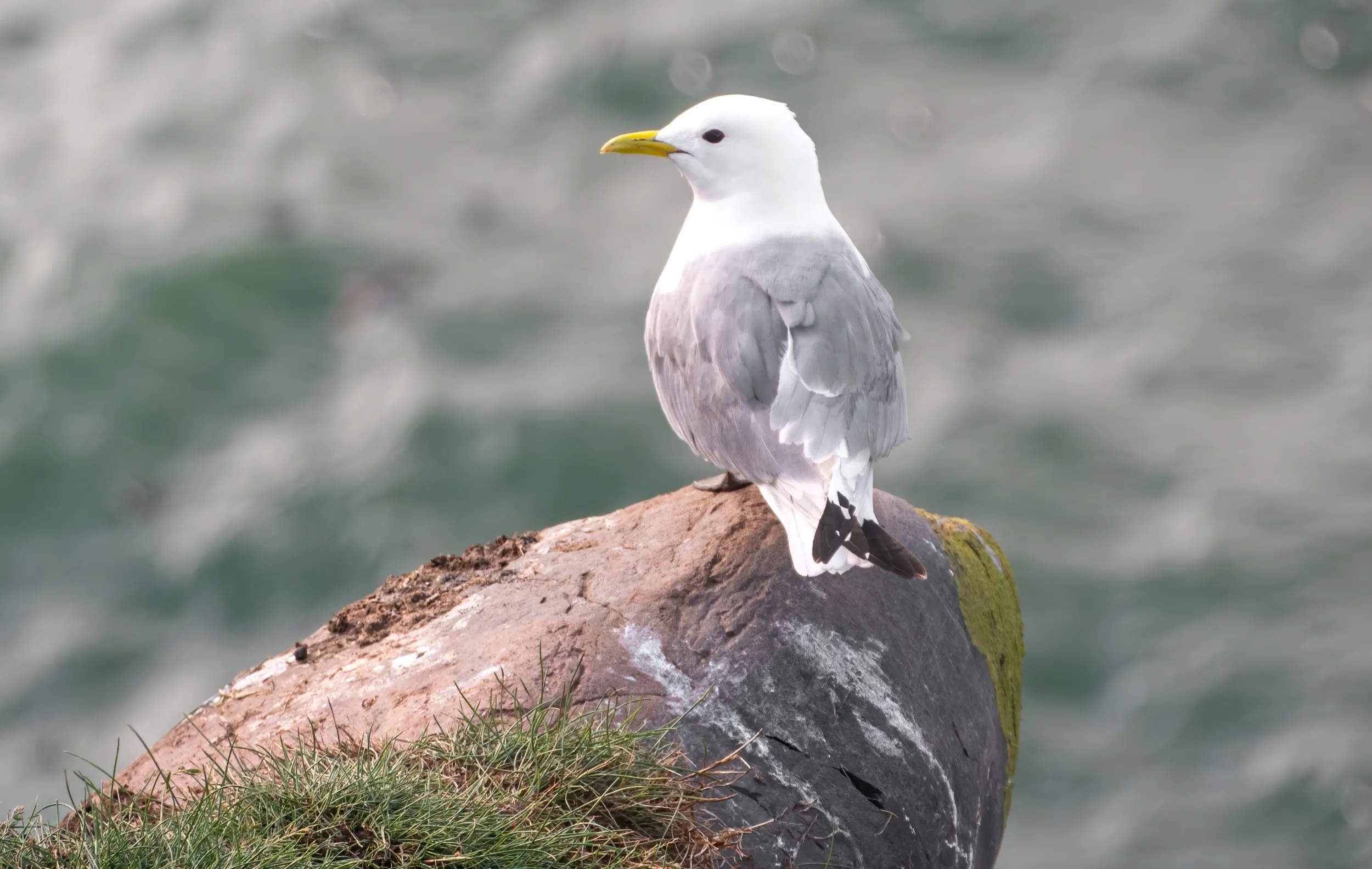
A member of the gull family and very sweet looking! They have grey wings with ink-dipped tips, yellow beaks and black legs. They can be seen from February to August around the UK. The largest inland breeding colony nests on the Tyne Bridge in Newcastle. Red listed as most at risk and of highest conservation concern.
A very stylish looking medium sized seabird, part of the auk family. They can be spotted nearly all around the UK from March to July. They are black and white with a thick, black, blunt beak that has a white vertical stripe. Amber listed.

The most common member of the auk family that can be spotted from March to July on steep cliff edges around the UK. They are a lovely chocolate brown and white bird with a long pointed black beak. Amber listed.

The second largest gull in the UK. They have suffered a 60% population decline since 1986 due to a reduction in their traditional food sources. Herring Gulls can be spotted all year round. They can be seen nesting in seabird colonies, as well as in urban areas and around landfill sites. They have pale grey back with black tips and pink legs. Red listed.

A member of the auk family, well known for their distinctive black heads, white cheeks and colourful bill. Puffins can be spotted from April to July on some of our sea cliffs around the UK. Red listed.

Seabirds return to our coast in spring to breed. The sight and sound of a noisy ‘seabird city’ is an exhilarating experience and we’d love to welcome you to one of our nature reserves. Top sites include:
Bempton Cliffs, England
South Stack, Wales
Rathlin Island, Northern Ireland
Fowlsheugh, Scotland
Have you heard of the Fern Owl, the Wheeler, the Dor-hawk or maybe the Goatsucker? These are names that have been given to the incredibly elusive Nightjar!
There isn’t another species of bird in the UK that looks and behaves quite like the Nightjar. Nocturnal, elusive, well camouflaged thanks to their mottled bark-like plumage, and with a unique trilling call, Nightjars have inspired a few folktales.
Nightjars have been known as Goatsuckers, as it was believed that they would drink milk directly from goats, and bizarre as it sounds this was once a common myth in many European countries. They were also once considered an omen of impending death as the ‘churring’ sounds they make were compared to the ticking of a clock, suggesting that someone’s time was up!
Although the Nightjar may come with an eerie reputation, they are wonderful birds with fascinating hunting adaptations. Like owls they are capable of silent flight – although when displaying for females or protecting a territory they can noisily clap their wings.
They also have prominent rictal bristles (whisker like feathers around their beak) which unfold to form a natural insect trap. It is believed they provide a sensory function when foraging in low light. And they have an exceptionally wide gape for catching moths and beetles on the wing.
Nightjars are migrant birds that arrive in the UK from the Democratic Republic of the Congo in late April and start leaving at the end of August. They are most numerous in southern England but are also found in parts of Wales, northern England and southwestern Scotland. They breed in habitats such as heathland, moorlands and woodland clearings and lay an average of two eggs on bare ground.
To find out more about these fantastical birds, why not come along to a Nightjar safari on an RSPB nature reserve.

I am a wildlife enthusiast and keen bird ringer who is always learning something new and fascinating about our natural world. I enjoy encouraging others to help wildlife in whatever small way they can and I am often distracted and amused by my garden visitors, especially Woodpigeons.