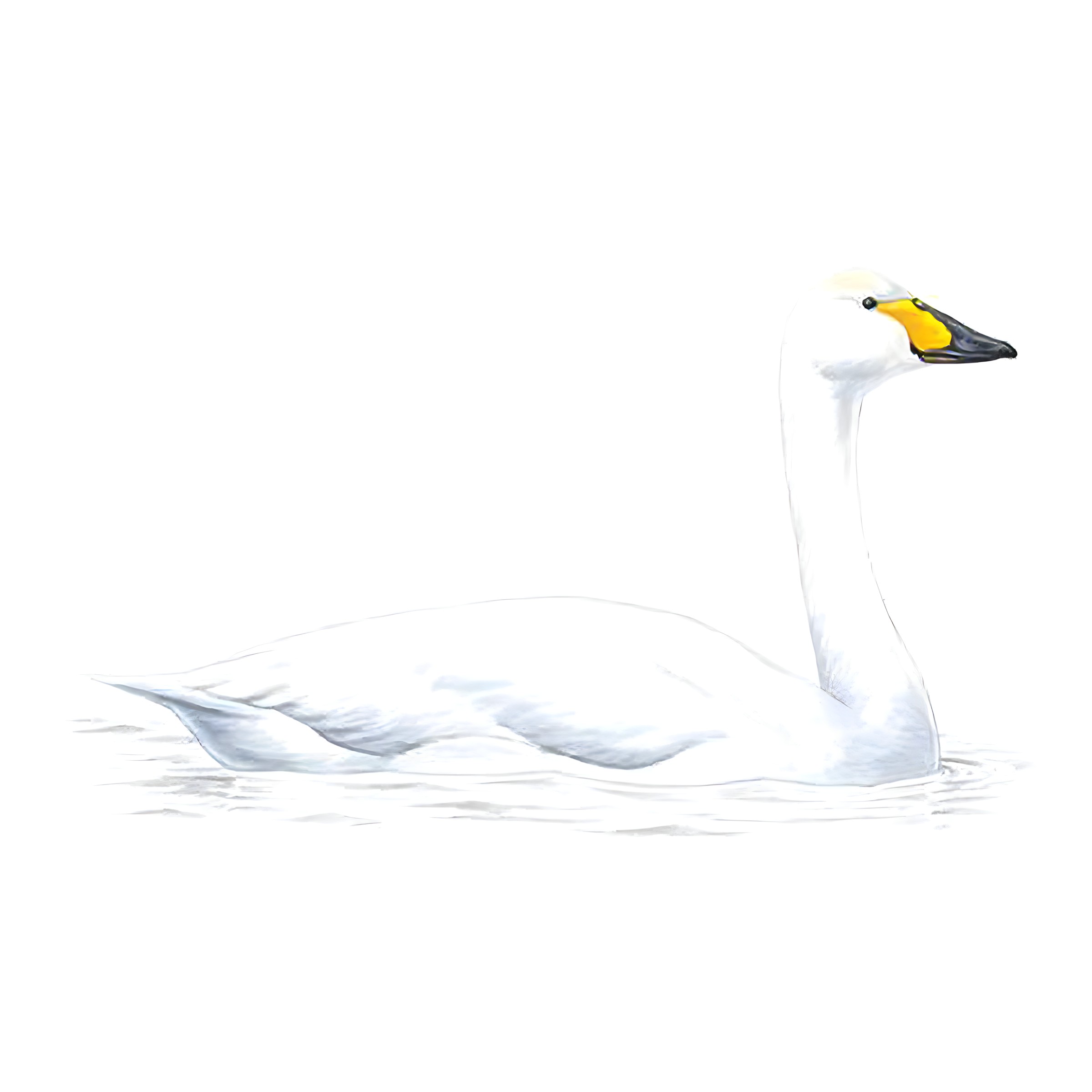
How to identify

Bewick's Swan adults are white all over with a black and yellow bill, while young birds are greyish with a pinkish bill. Compared to the similar Whooper Swan, these swans have proportionally more black and less yellow on their bill. They're also smaller than both Mute and Whooper Swans and have faster wingbeats. Bewick's Swans are a Schedule 1 species, meaning it's illegal to intentionally or recklessly disturb them.

Call

Bewick's Swan

Grzegorz Lorek / xeno-canto

Key features to look out for

  • The UK’s smallest swan
  • Shorter, straighter neck than a Whooper Swan
  • Black and yellow beak – but with less yellow than a Whooper Swan
  • Young birds have a pinkish beak
  • Adults are white, juveniles are pale grey
  • Head is more rounded than a Whooper’s
Bewick's Swan, adult swimming
Bewick's Swan
Did you know?

The yellow markings on a Bewick's Swan's bill are unique to each bird. Because of this WWT have been able to monitor Bewick’s Swans returning to Slimbridge in Gloucestershire for more than 60 years – one of the longest running studies of a single species ever! 

Conservation status

Bewick’s Swans were added to the Red List of UK Birds of Conservation Concern in 2021. Pressures include illegal hunting abroad, ingestion of lead ammunition, and the impacts of climate change and habitat loss.  

In 2025, the UK Government has announced new restrictions on the use of lead in ammunition, following campaigning by the RSPB, WWT and other conservation organisations.  

Bewick's Swan, adult feeding in field
Bewick's Swan

Bewick’s Swans are the smallest species of swan that you can see in the UK. Not much bigger than a Canada Goose, these are also our rarest, with numbers dropping sharply over recent years. Recent evidence from WWT, the charity for wetlands and wildlife, suggests that Britain could have lost up to 43% of its population of Bewick’s Swans in just five years. 

Where and when to see them

Difficulty rating - Moderate to hard

Bewick’s Swans usually start arriving in the UK from November and depart in February and March. For the best chance of seeing them, head to the wetlands and low-lying farmland of eastern England and the Severn Estuary. The RSPB’s Ouse Washes and Nene Washes nature reserves in Cambridgeshire are great places to spot them.

Key

  1. Resident
  2. Passage
  3. Summer
  4. Winter
* This map is intended as a guide. It shows general distribution rather than detailed, localised populations.
UK distribution map for Bewick's Swan
  1. Jan
  2. Feb
  3. Mar
  4. Apr
  5. May
  6. Jun
  7. Jul
  8. Aug
  9. Sep
  10. Oct
  11. Nov
  12. Dec

Behaviour

The swans migrate here for the winter but large numbers are now ‘short-stopping’, choosing to spend the winter months in wetlands in central Europe rather that flying to the UK. Climate change means the birds don’t need to fly as far to find ice-free wetlands so they are wintering in Denmark, Germany and the Netherlands rather than the UK.

During migration, Bewick’s Swans travel in close-knit family groups and cygnets learn the route, as well as important stopover and feeding sites, from their experienced parents. Some youngsters stick close to their parents for several years, until they find a partner of their own.

Once in the UK, these Arctic visitors roost on open water overnight, then venture out to feed on leftover crops in nearby fields during the day. They also eat aquatic plants, like pondweed.

Call/song

Bewick’s Swans have a soft, bugling call that’s more musical than a Whooper’s. They’re very vocal birds and families will call to each other while flying, to ensure they don’t get separated.

Nesting

Bewick’s Swans breed on the tundra of Siberia. With the Arctic summer lasting only a few short months, they face a race against time to raise their chicks before winter closes in. The pair builds a nest together, and the female lays three to five eggs, which both parents help to incubate.

Bewick's Swan, close up of adult
Bewick's Swan
Your guide to the UK’s swan species

Get to know these snow-white beauties with our handy ID guide.

Key facts