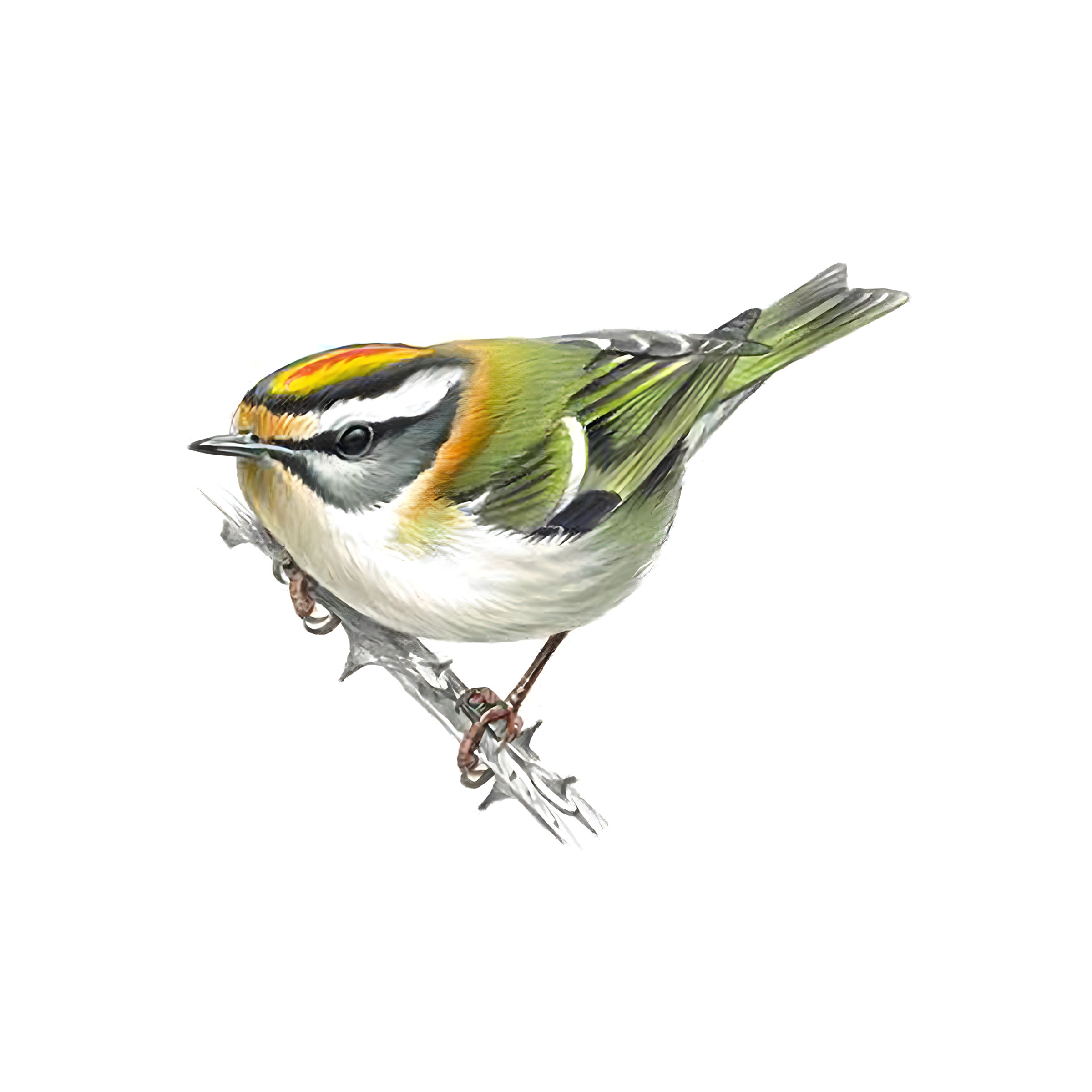
How to identify

This tiny, restless jewel of a bird vies with the Goldcrest for the title of the UK's smallest bird. Compared to the Goldcrest, the Firecrest is brighter and 'cleaner' looking, with a green back, white belly, bronze 'collar' and a black and white eye-stripe. They have a yellow and black stripe on their heads, which has a bright orange centre on males. Like Goldcrests, they move through trees and bushes in search of small insects.

Call

Firecrest

Patrik Åberg / xeno-canto

Key features to look out for

  • Distinctive white ‘eyebrow’ stripe above the eyes – Goldcrests don’t have this 
  • Black cap with a vivid orange stripe – yellow in females
  • Bright olive-green back
  • Bronze ‘collar’ around the neck
  • White underparts 
  • Slightly larger than Goldcrests (about 10cm vs 9cm) 
  • Sleeker, more streamlined look than the dumpy Goldcrest

Conservation status

Firecrests are on the Green List. 

When and where to see them

Difficulty rating: Hard

Firecrests love mature woodland with plenty of conifers, but they’ll happily explore mixed or broadleaf woodland with dense undergrowth. Like Goldcrests they’re endlessly busy, flitting about in search of insects high in the trees, but they will also venture down into scrub and bushes more often than their cousins. You’re most likely to spot them in southern England, where they breed, though winter migrants from continental Europe could pop up more widely. 

Firecrests are much scarcer than Goldcrests in the UK, although their numbers are on the rise. You’ll need patience and a keen eye to catch a glimpse of these fast-moving little birds, but now is the best time to look, as winter migrants boost your chances.  

Key

  1. Resident
  2. Passage
  3. Summer
  4. Winter
* This map is intended as a guide. It shows general distribution rather than detailed, localised populations.
  1. Jan
  2. Feb
  3. Mar
  4. Apr
  5. May
  6. Jun
  7. Jul
  8. Aug
  9. Sep
  10. Oct
  11. Nov
  12. Dec
Firecrest
Birds of the month

Head outside and discover fascinating birds each month. Read on for top ID tips, what to listen for, and where to see them.

Key facts