How to identify

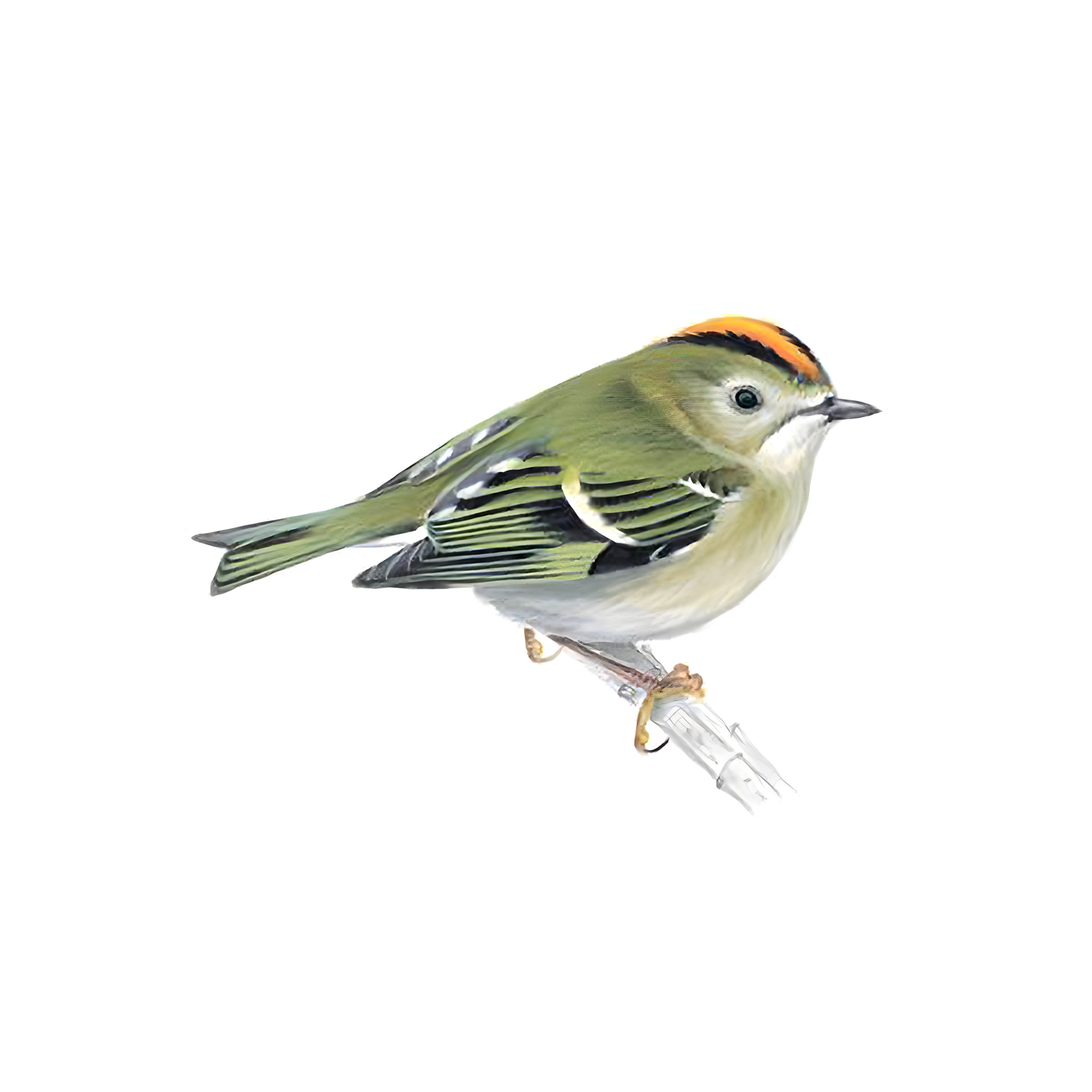
Along with the Firecrest, the Goldcrest is the UK's smallest bird. They're dull greyish-green with a pale belly and a black and yellow stripe on their heads, which has an orange centre in males. Their thin beak is ideally suited for picking insects out from between pine needles.

Call

Goldcrest

Patrik Åberg / xeno-canto

Key features to look out for

  • Weighing in at an average of just 6g – that’s the equivalent of about six paperclips Goldcrests are the UK’s smallest birds.
  • Black cap with a bright yellow stripe – orange in males
  • Large dark eye with a pale eye ring 
  • Olive-green body
  • Pale belly
  • White wing bars with dark flight feathers 
  • Cute, tubby, rounded shape

Conservation status

Goldcrests are on the Green List of least conservation concern. 

When and where to see them

Difficulty rating: Medium

Each autumn, our resident Goldcrests are joined by reinforcements that fly here all the way from Scandinavia and Russia to make the most of our milder weather.  

Goldcrests are widespread across the UK. You’re most likely to spot them flitting about in the treetops of conifer and mixed woodlands, though they’ll also visit parks and gardens with mature trees.  

They’re incredibly active little birds and often dangle upside down as they hunt for insects hidden in the foliage. Winter is prime Goldcrest-spotting season, as migrant arrivals boost numbers. Goldcrests often tag along with roaming tit flocks – so if you think you’ve spotted a Blue Tit, it’s always worth a second look!  

Goldcrests are quite common, but their tiny size and love of the treetops mean they can be easy to overlook.  

Key

  1. Resident
  2. Passage
  3. Summer
  4. Winter
* This map is intended as a guide. It shows general distribution rather than detailed, localised populations.
  1. Jan
  2. Feb
  3. Mar
  4. Apr
  5. May
  6. Jun
  7. Jul
  8. Aug
  9. Sep
  10. Oct
  11. Nov
  12. Dec

Behaviour

Nesting

Goldcrests, along with the closely related Firecrest, are the UK’s smallest birds. Weighing the same as a 20-pence piece, these tiny birds are susceptible to the cold weather, and it’s thought that eight out of ten Goldcrests die each winter. Consequently, large clutches are essential for the success of the population, and female Goldcrests can lay up to 12 eggs, weighing one and a half times her body weight!  

Did you know?

People once found it so hard to believe that such delicate birds could flap their way across the North Sea that they thought Goldcrests must hitch a ride on the back of migrating Woodcocks! This led to them being nicknamed ‘Woodcock pilots’. Nowadays we know that these tiny travellers are perfectly capable of making the journey all by themselves. 

Goldcrest
Birds of the month

Head outside and discover fascinating birds each month. Read on for top ID tips, what to listen for, and where to see them.

Key facts