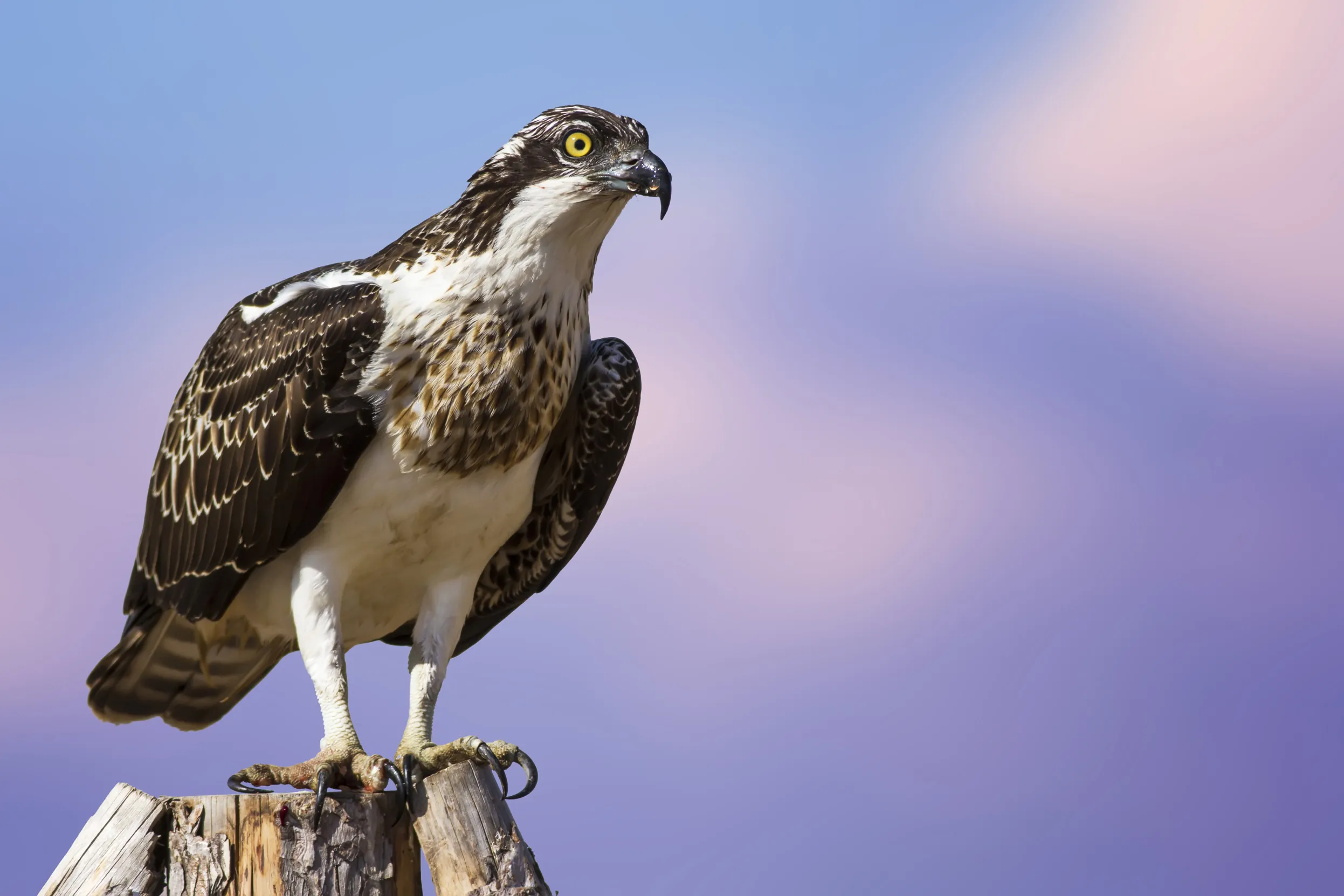
How to identify

When seen in flight from below, the Osprey has white or slightly mottled underparts. The wings are angled, bending at the 'wrist' (middle) which has a black patch contrasting with the white wing linings and, at a distance, it could be mistaken for a large gull. This spectacular fish-eating bird of prey is an Amber List species because of its historical decline (due to illegal killing) and low breeding numbers. They are listed as a Schedule 1 species on The Wildlife and Countryside Act.

Call

Osprey

Patrik Åberg / xeno-canto

Key features to look out for

  • Males and females look very similar, with brown upperparts and white underparts 
  • Juvenile birds have buff tips to their feathers, giving them a scaly appearance 
  • Females are larger and tend to have a ‘necklace’ of brown feathers on their chest 
  • White head with distinctive dark eye ‘mask’ 
  • Black beak 
  • Adults have yellow eyes, juveniles have orange eyes 
  • Pale grey legs, not yellow as in many other birds of prey 
  • Wings angled at the ‘wrist’ making Ospreys look a bit like gulls at a distance
Osprey in flight over a lake.
Osprey
What’s that bird of prey

From tiny Merlins to enormous White-tailed Eagles, the UK’s birds of prey come in all shapes and sizes. These masterful predators are a real treat to see, but they’re often super-fast and many species look quite similar, which can make identifying them a challenge. In this guide, we share some simple ID tips to help you.

Conservation status

They’re on the UK Amber List due to historical illegal killing, and the fact that breeding numbers are low. 

Where and when to see them

Difficulty rating - Hard

Ospreys breed by lochs and lakes. They’re increasing as a breeding bird and nesting in more and more places, but Scotland remains their stronghold. You might also spot them further south as they pass through on migration. 

Migration

The vast majority of our breeding Ospreys spend their winters in West Africa, though small numbers may go no further than Spain and Portugal. These large fish-eating birds became extinct in the UK in the early 20th century thanks to years of persecution. However, they returned to nest in Scotland in the 1950s and have continued to recolonise ever since and there are as many as 400 pairs now nesting across the UK annually. 

Key

  1. Resident
  2. Passage
  3. Summer
  4. Winter
* This map is intended as a guide. It shows general distribution rather than detailed, localised populations.
  1. Jan
  2. Feb
  3. Mar
  4. Apr
  5. May
  6. Jun
  7. Jul
  8. Aug
  9. Sep
  10. Oct
  11. Nov
  12. Dec

Behaviour

Ospreys are fish-eating birds of prey and you might see them soaring over a lake peering intently into the water, before hurtling downwards and diving in head-first, with their talons outstretched to grab their prey. They will also fly low over the water to snatch any unsuspecting fish that swim close to the surface.

  • They have a special extra eyelid – a bit like a contact lens – that helps to protect their eyes when they hunt under water.
  • To help them keep hold of their slippery prey, Ospreys have special spines on their feet and will hold the fish headfirst to limit air resistance and help with flight.
Female Osprey perched on a nest in morning light
Female Osprey
Birds of the month

Head outside and discover fascinating birds each month. Read on for top ID tips, what to listen for, and where to see them.

Osprey action at RSPB Loch Garten

Ospreys become locally extinct as a breeding bird in the UK by the early 20th century. However, in 1954, two breeding Ospreys from Scandinavia nested by Loch Garten in Abernethy Forest, and Ospreys have nested there ever since (apart from a short hiatus between 2016 and 2019).

Take a look at our camera to catch up with Ospreys as they build bonds, squabble and feast on fish. You might even catch a glimpse of Redstarts, Chaffinches and more of the surrounding Caledonian pine forest wildlife.

Osprey, adult female in flight with moss in talons
Osprey
Our wildlife camera livestreams

Catch up with Osprey antics, Capercaillie dust baths and our nature reserve bird feeders, no matter where you are.

Key facts