How to identify

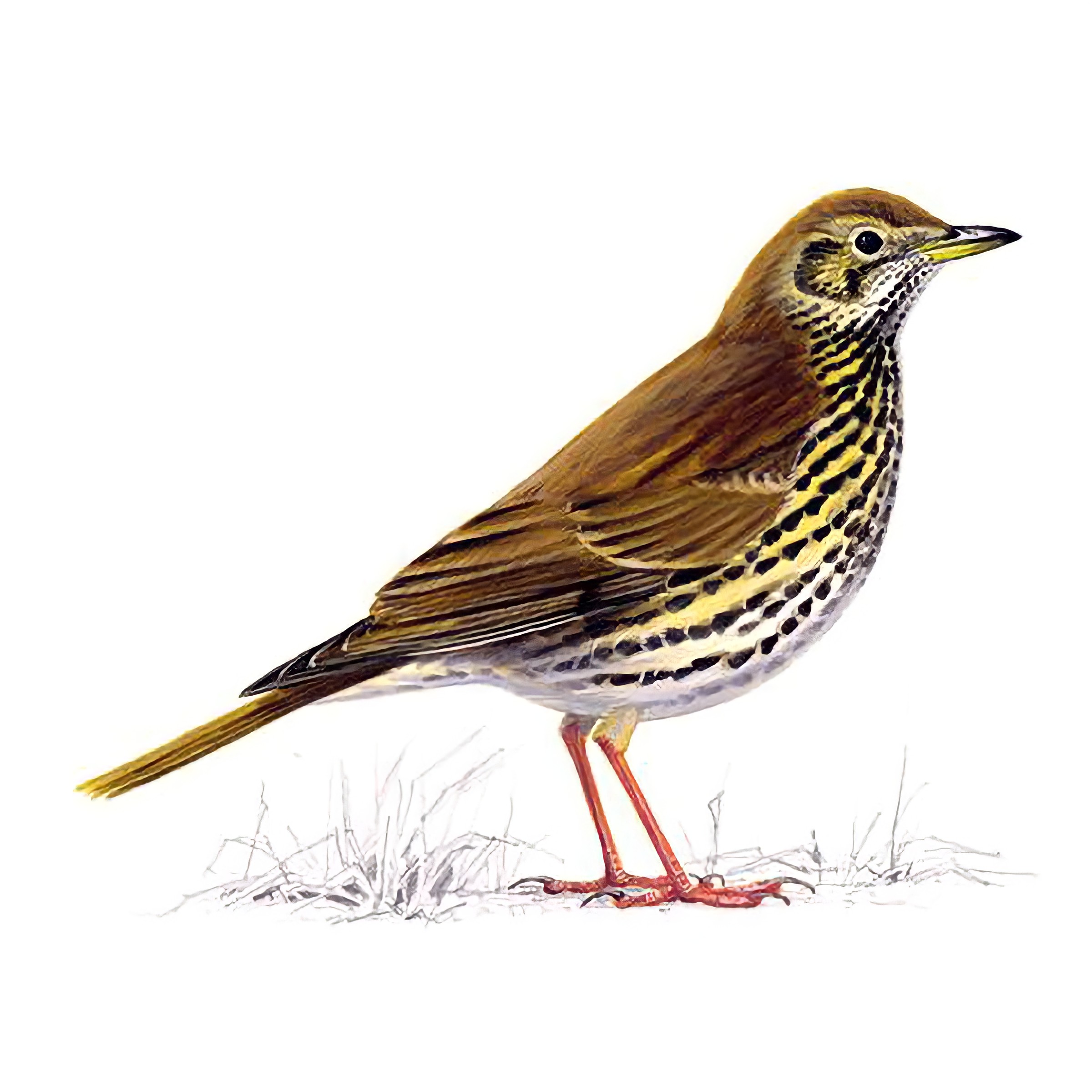
A familiar and popular garden songbird whose numbers have declined significantly on farmland and in towns and cities. It's smaller and browner than a Mistle Thrush with smaller spotting. Its habit of repeating song phrases sets it apart from singing Blackbirds. It likes to eat snails, breaking into them by smashing them against a stone with a flick of the head.

Call

Song Thrush

Patrik Åberg / xeno-canto

Key features to look out for

  • Smaller than Blackbird 
  • Warm brown above with speckles on a creamy white breast  
  • Spots on upper breast are like upside-down hearts
A Song Thrush singing from a tree.
Song Thrush
How to identify the UK’s thrushes, including two special winter visitors

Get to know the UK’s thrushes, including the Fieldfares and Redwings that flock here for the winter.

Redwings and Fieldfares are both species of thrush and in this feature, we take a look at these and other thrushes that are found in the UK. Read on to find out more about this fascinating family of birds and for ID tips. 

Conservation status

The Song Thrush is on the Amber list of Conservation Concern because of the declines it has suffered.

Where to see them

Difficulty rating - Easy/moderate

Song Thrushes are widespread in gardens, parks and woodland, though they have suffered big declines in the past 30 years so are not as common as they once were.

Key

  1. Resident
  2. Passage
  3. Summer
  4. Winter
* This map is intended as a guide. It shows general distribution rather than detailed, localised populations.
  1. Jan
  2. Feb
  3. Mar
  4. Apr
  5. May
  6. Jun
  7. Jul
  8. Aug
  9. Sep
  10. Oct
  11. Nov
  12. Dec

Behaviour

A tell-tale sign that you have a Song Thrush nearby is broken snail shells next to a stone, wall or something hard that they use as an anvil to get at the snails inside. 

Call/song

Its call is a simple ‘tsit’. It repeats each part of its song, sometimes three times and hence its old-fashioned name of ‘thricecock’, sometimes more.

Did you know?

Famed and named for its characterful vocalisations, this thrush has a pretty impressive repertoire. Its distinctive song is made up of multiple parts, with each short phrase repeated two or three times before it bounds swiftly on to the next one. 

A lone Song Thrush, perched on a flat rock in low, golden sunlight.
Song Thrush
Birds of the month

Head outside and discover fascinating birds each month. Read on for top ID tips, what to listen for, and where to see them.

Key facts