
How to identify
Learn more about how to identify Tawny Owls, and find out which RSPB reserves are best to see them.
Wrap up warm and head outside – now’s the perfect time to spot owls and geese.

With temperatures dropping and the nights drawing in, November can sometimes feel a little gloomy, but don’t be tempted to hide away indoors – it’s actually a wonderful month to get out and about in nature. Geese will be arriving in huge, noisy flocks and it’s one of the best times of year to see and hear owls.
Here's our pick of species to spot this month:
Ask someone to do their best owl impression and they’ll probably reply with a classic ‘twit-twoo’. That’s the call of a Tawny Owl. Well, two Tawny Owls actually! It’s the female who makes the sharp ‘twit’ call and the male that replies with a drawn-out ‘twoooo’.
In autumn, young Tawny Owls are kicked out of home by their parents and will be noisily trying to stake a claim to their own patch of woodland, making it a great time to listen out for these hooting hunters.
You’ll need to head out after dusk for a chance of hearing the famous Tawny Owl duet.


Tawny Owls usually live in broadleaved woodlands, but you might spot them in parks and large gardens with mature trees. They’re found in England, Scotland and Wales, but not Ireland.
Hard – Tawnies are night owls in every sense, so you’re more likely to hear their hoots than see their faces. But if you’re really lucky, you might spot one snoozing in a tree during the day.
Tawny Owls are the most common owls in the UK, but they declined by more than 40% between 1995 and 2023 and are now on the Amber List of Birds of Conservation Concern. Because they only come out at night, they’re tricky to study and scientists don’t yet know the reasons for their decline, but habitat loss and a lack of prey might be part of the problem.
Learn more about how to identify Tawny Owls, and find out which RSPB reserves are best to see them.
Catch a glimpse of a Barn Owl drifting silently over a moonlit field at twilight, and you’ll understand why these ethereal hunters are nicknamed ‘ghost owls’.
Their super-sharp eyesight helps them to spot mice and voles in low light, but they also have another trick up their feathery sleeves – a ‘satellite dish’ of stiff facial feathers which helps to funnel the faint rustles of rodents towards their ears, helping them to pinpoint the precise location of their unsuspecting prey, even under a layer of snow!
If you’ve never seen a Barn Owl, now is a great time to look, as during cold weather they’re often forced to hunt during daylight to find the extra food they need to survive.
Barn Owls may look angelic, but their call is anything but. Instead of a gentle hoot, they let out a shrill, screeching cry – it’s a sound you won’t forget in a hurry and one that gave them their other nickname of the ‘screech owl’.


Look out for Barn Owls perched on fence posts or flying low over farmland and rough grassy areas — especially at dawn or dusk. You’ll need to keep your eyes peeled though, as their silent flight makes them easy to miss.
Medium – Barn Owls are easier to spot than some other owls, especially in autumn and winter when they hunt during the day. They sometimes hunt along country roads, so keep a lookout for a ghostly white shape in your car headlights.
Barn Owls are on the Green List of least conservation concern.

Learn more about how to identify Barn Owls, and find out which RSPB reserves are best to see them.
With a name like ‘Short-eared Owl’ you’d be forgiven for assuming that these birds must have obvious ears. But ‘Shorties’, as they’re affectionately known, usually keep their stumpy little ear tufts flattened down, unless they’re alarmed. And – we hate to break this to you – those ‘ear tufts’ aren’t actually ears at all. They’re just feathers. Their real ears are hidden away on the sides of their head.
Unlike Tawny Owls, which have dark eyes, Shorties have piercing yellow eyes, surrounded by dark feathers, which make them look like they got a bit carried away with the eyeliner! In fact, the colour of an owl’s eye can give you a handy clue about when they’re likely to be out and about. Owls with yellow eyes, like Shorties, tend to hunt during the day, while owls with dark eyes prefer the night shift.
Shorties aren’t the chattiest of owls, but during the breeding season you might hear a series of soft, barking hoots or a raspy call.


Short-eared Owls breed in the uplands, on moorlands and rough grasslands. But during the winter they’re much more widespread, turning up in lowland areas and around the coast – so keep an eye out for them hunting over fields, marshes and wetlands.
Medium – Short-eared Owls are active during the day, which makes them easier to spot than most. But their camouflage is excellent, and they often perch low to the ground, so you’ll need sharp eyes and a bit of patience. There are Shorties in the UK all year round, but now is a great time to see them as more join us from Scandinavia, Russia and Iceland to escape the freezing conditions further north.
Short-eared Owls are currently on the Amber List of Birds of Conservation Concern. Their numbers fluctuate depending on prey availability and habitat conditions.

Learn more about how to identify Short-eared Owls, and find out which RSPB reserves are best to see them.
Every autumn, the skies come alive with huge squadrons of Pink-footed Geese flying in V-formations overhead, filling the air with their cheerful honking. It’s one of the season’s great spectacles – like nature’s version of rush hour, but with less road rage.
‘Pinkies’ are quite dumpy, and they don’t look like the most flexible of birds. But don’t be fooled – they can perform some pretty amazing acrobatics in mid-air. If they need to land quickly, they will start to twist and turn to slow themselves down – a trick known as whiffling. Sometimes they will even flip their body and fly upside down, while keeping their head upright!
Their call is a high-pitched, cheerful ‘wink-wink’ – often heard before you see them. Their calls build to a noisy chorus when flocks take off or land.
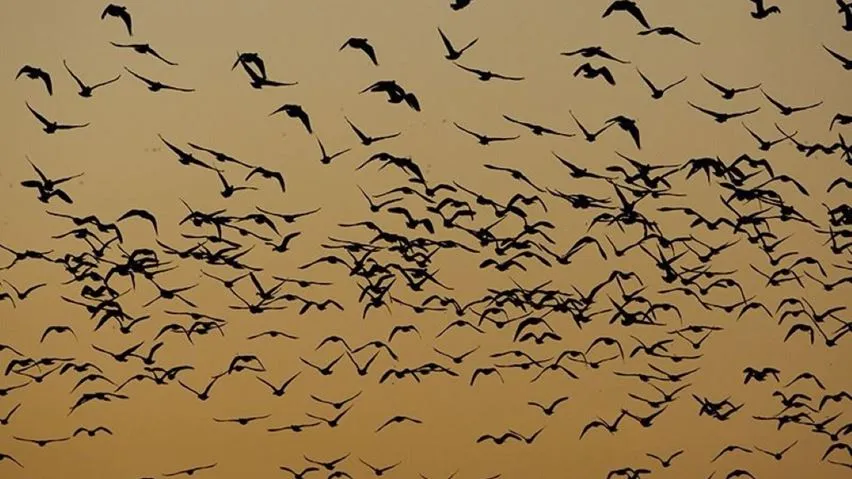


Look for Pink-footed Geese on estuaries, wetlands, and farmland — especially in eastern and northern England and parts of Scotland. Early mornings and late afternoons are best, when flocks are commuting to and from their feeding and roosting grounds.
Easy to Medium – Large numbers of Pink-footed Geese will be arriving from Iceland and Greenland to spend the winter here, so now’s the perfect time to wrap up warm and head out to watch some whiffling.
Pink-footed Geese are currently on the Amber List.

Learn more about how to identify Pink-footed Geese, and find out which RSPB reserves are best to see them.
Smartly dressed in black, white and grey, Barnacle Geese look like they’re off to a fancy ball – and they certainly know how to make an entrance. In autumn, thousands of these dapper geese arrive on our shores en masse, bolstering the growing feral population that now breeds in the UK.
For centuries, their sudden appearance was a complete mystery. No one had ever seen their nests, eggs or chicks – the adults just flew in, fully formed, across the sea. So what was going on? One popular theory was that they didn’t hatch from eggs at all, but from barnacles clinging to driftwood out at sea!
It sounds bonkers now that we know about bird migration, but back then it made perfect sense – especially given the resemblance between the black-and-white stripes on Goose Barnacles and the geese themselves. So the myth stuck – and so did the name!
Their call is a high-pitched, yapping chatter — often heard as flocks fly overhead or settle to feed.
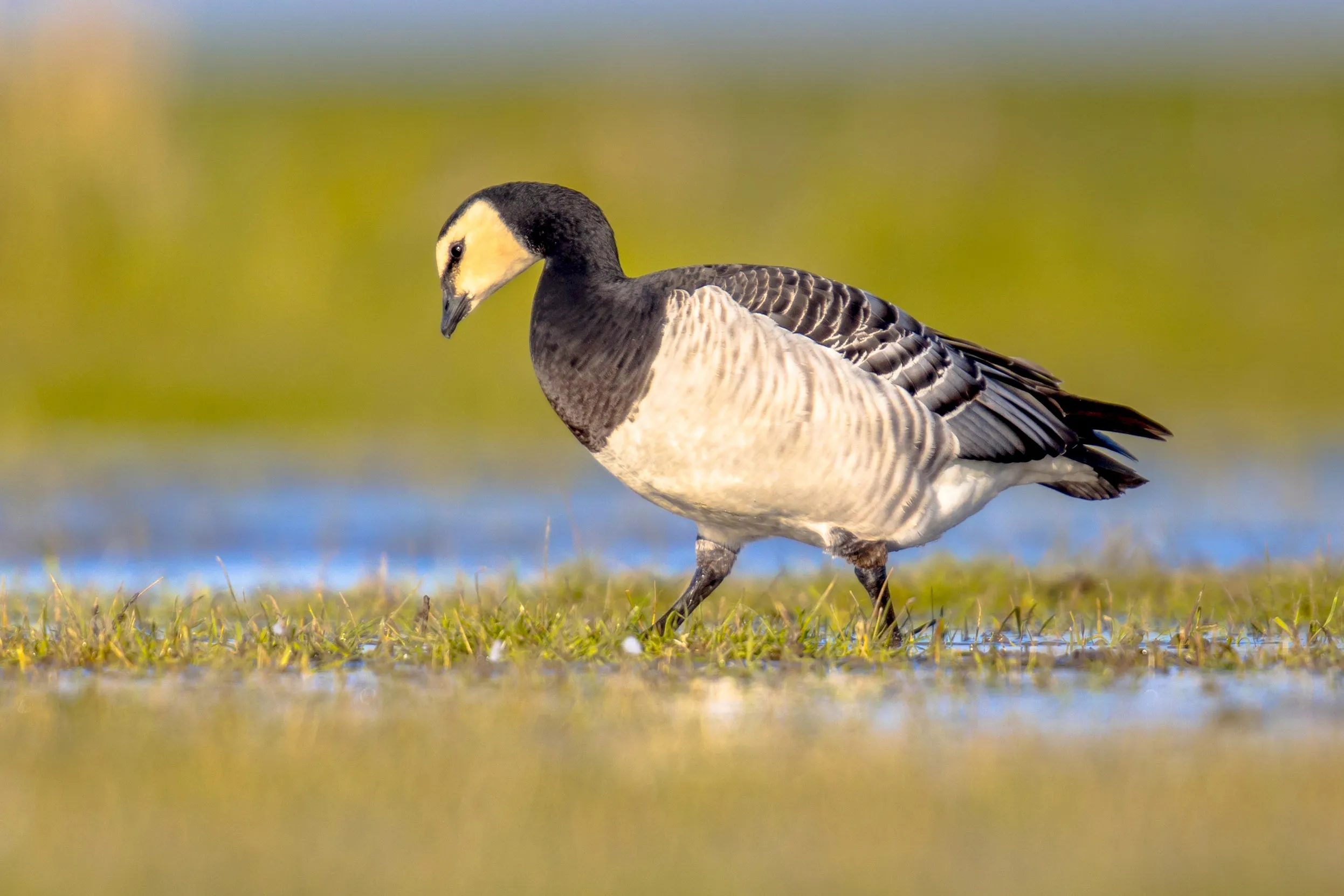


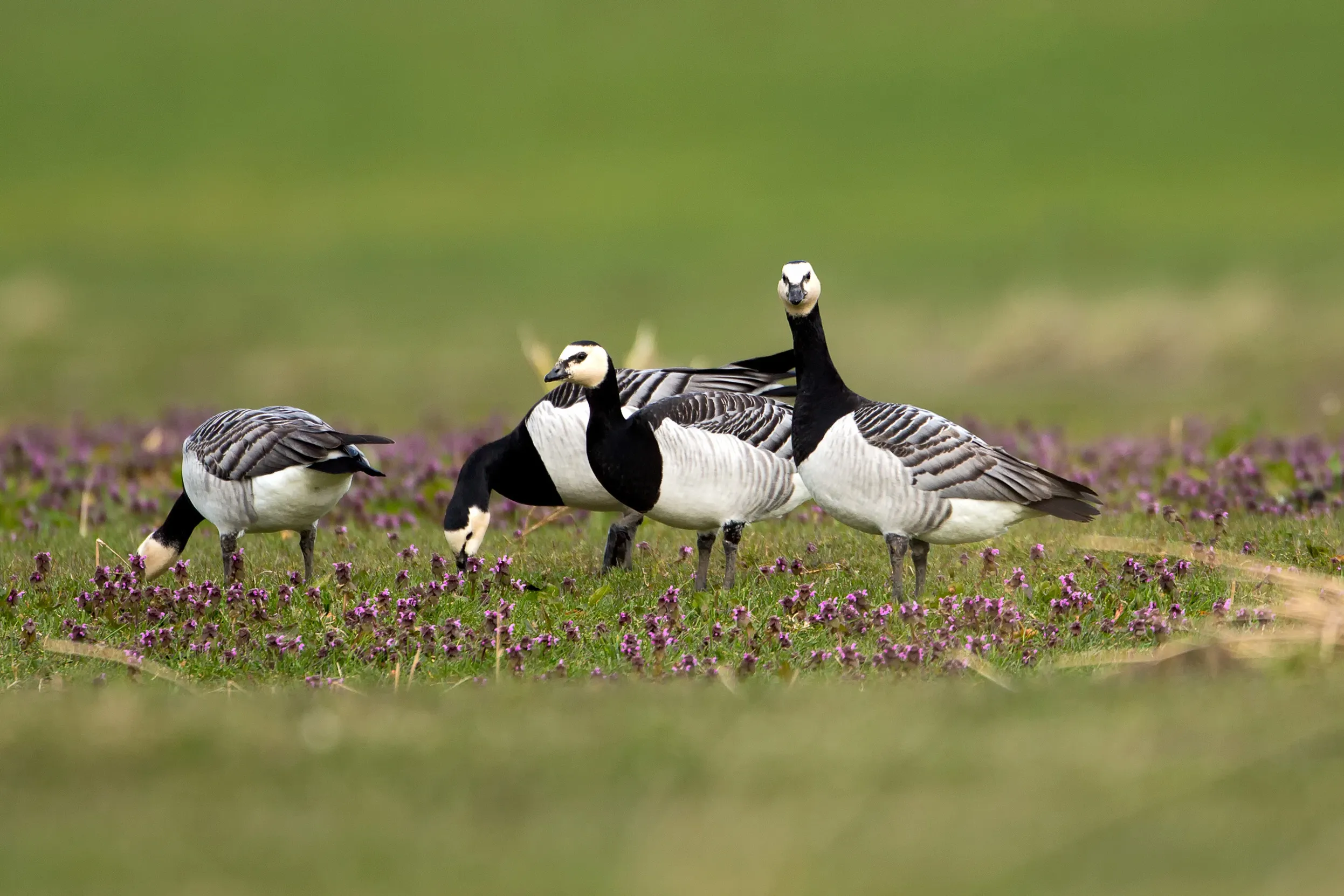
Wild Barnacle Geese only visit the UK in autumn and winter, migrating from Greenland and Svalbard to spend the colder months on coastal wetlands and estuaries in Scotland, northern England and Ireland. Feral birds can be seen year-round, nesting on gravel pits and lakes — but the real spectacle comes with autumn’s Arctic arrivals.
Easy to Medium – Barnacle Geese gather in large, vocal groups, making them relatively easy to spot.
Barnacle Geese are on the Amber List.
Learn more about how to identify Barnacle Geese, and find out which RSPB reserves are best to see them.
Dinky, dark and delightfully chatty, Brent Geese may be the smallest of the UK’s geese, but they’re big on character. They’re devoted family birds and will stick together in tight-knit groups, often returning to the same wintering haunts year after year, with their mates and youngsters in tow.
Their name comes from the Old Norse word for ‘burnt’ – a nod to their smoky black feathers – but there are actually a few different subspecies of Brent Goose with different colouration and travel itineraries.
In autumn, Dark-bellied Brent Geese travel to the south and east coasts of England from the frozen tundra of Siberia and Russia, while Light-bellied Brent Geese make the journey from Greenland to Ireland and western Britain. There’s also a small population of Light-bellied Brent Geese from Svalbard that spends the winter around Lindisfarne in Northumberland.
Their call is a gentle, bubbling murmur, unlike the loud honks of many other geese.

.jpg)


Brent Geese are coastal specialists. Look for them on estuaries, saltmarshes, and mudflats, where they feed on eelgrass, marine algae and saltmarsh plants. You might also see some birds, especially in southern England, feeding on grassland.
Easy to Medium – Brent Geese often gather in large flocks, making them easy to spot if you’re in the right place.
Brent Geese are currently on the Amber List of Birds of Conservation Concern. While their global population is stable, they rely heavily on protected coastal habitats, which are vulnerable to development and climate change.
Learn more about how to identify Brent Geese, and find out which RSPB reserves are best to see them.
We hope you feel inspired to try and see some of these birds this month. We’d love to hear how you get on. You can share your photos with us at NotesonNature@rspb.org.uk We’ll share some of the best in a future issue of Notes on Nature.
Please be mindful when taking photos not to disturb wildlife or habitats. Further guidance can be found in The Nature Photographer's Code of Practice.


